
🚩 Evidence Flags: More trust signal, fewer words (English Version)
🚩 Indicadores de evidencia: Más señales de confianza, menos palabras
Cuando le pido algo a Copilot, normalmente responde con seguridad. El problema es que, en la misma respuesta, puede mezclar lo que ha comprobado en un archivo, lo que yo le he contado y una conclusión propia. Todo parece tener el mismo nivel de certeza, aunque no lo tenga. Y así es fácil tomar decisiones sin distinguir bien qué está realmente respaldado.
Esa fue la incomodidad que quise resolver con esta skill: Evidence Flags. En vez de llenar la respuesta de matices como “puede que”, “creo que” o “parece que”, se añade una etiqueta breve a las afirmaciones relevantes. Así se intenta dejar claro si algo está respaldado, si procede de una fuente o si es una deducción del modelo.
Dos familias, siete etiquetas. Es todo el vocabulario.
Procedencia: ¿De dónde viene la afirmación?:
| Bandera | Pregunta | Significado |
|---|---|---|
| ✅ Respaldado | ¿Qué demuestra la evidencia? | La afirmación exacta está apoyada por evidencia inspeccionada. |
| 📎 Declarado | ¿Quién afirma esto? | Lo afirma el usuario, una persona o una fuente. |
| ❓ Sin comprobar | ¿Qué falta revisar? | Es importante, pero no tiene respaldo inspeccionado. |
Análisis de la IA: ¿Qué está haciendo el modelo?:
| Bandera | Pregunta | Significado |
|---|---|---|
| 🧩 Deducido | ¿Qué se desprende de la evidencia? | Conclusión razonada a partir de la evidencia. |
| 🧪 Hipótesis | ¿Qué podría explicarlo? | Explicación que necesita una prueba. |
| 🔮 Previsión | ¿Qué podría ocurrir? | Estimación futura con supuesto o plazo. |
| 🧭 Criterio | ¿Qué conviene hacer y por qué? | Recomendación basada en un criterio. |
Y dos avisos opcionales que suelen ahorrar disgustos: ⚠️ En disputa (fuentes creíbles se contradicen) y ⏱️ Sensible al tiempo (depende de fecha o versión).
Cuándo entra en acción: No quería que las etiquetas aparecieran en todas las conversaciones ni convertir una pregunta sencilla en algo más pesado. Por eso Evidence Flags solo se usa cuando lo pides explícitamente.
/ef              Etiqueta esta respuesta
/ef on           Mantén las banderas en las siguientes
/ef off          Desactívalas
/ef check        Comprueba antes de etiquetar
/ef trail        Muestra de dónde sale cada afirmación
También puedes combinar opciones, por ejemplo: /ef on check trail.
Unos ejemplos:
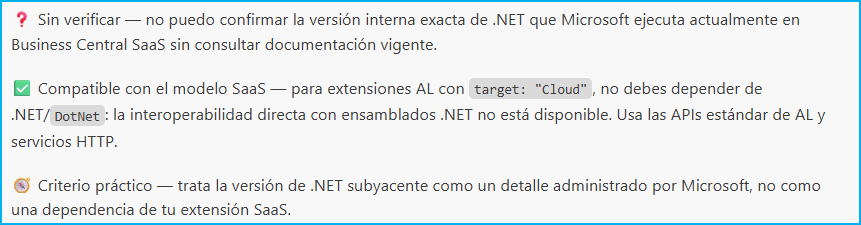
/ef ¿Qué versión de .NET usa Business Central SaaS actualmente?
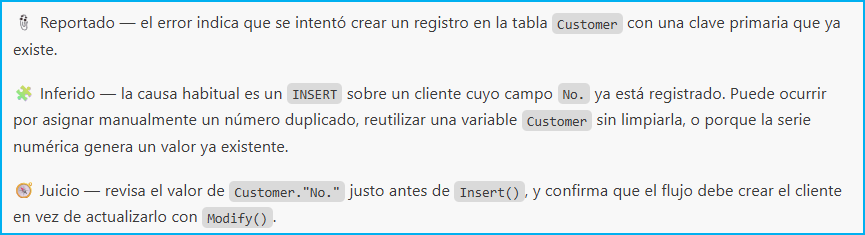
/ef En mensaje de error indica: "The record in table Customer already exists". ¿Cuál es la causa?
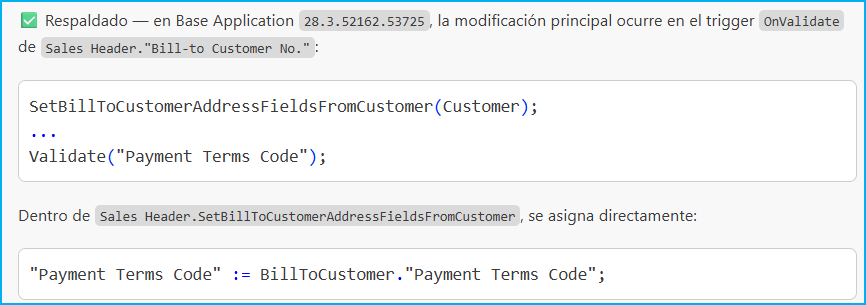
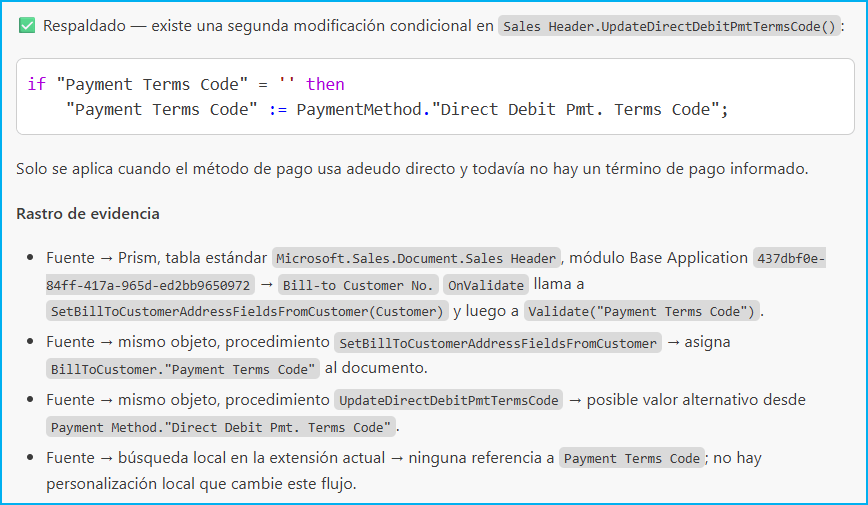
/ef check trail ¿Dónde se modifica el campo "Payment Terms Code" durante la creación de un pedido de venta?
Lo que no hace:
- No verifica automáticamente que una afirmación sea verdadera.
- No asigna una puntuación de confianza.
✅ Respaldadono significa “verdad absoluta”: indica que la afirmación está apoyada por evidencia que el modelo ha inspeccionado en esa conversación.- No sustituye una revisión técnica ni la validación en tu entorno.
- No se activa por defecto: para conversaciones normales, código, JSON o contenido creativo, Copilot responde como siempre.
- Las banderas solo aparecen cuando las activas con
/ef.
La skill ya está publicada aquí gdrgdev/evidence_flags y la he probado con casos normales y con algunas trampas: etiquetas forzadas, fuentes que intentan dar instrucciones y respuestas sin evidencia suficiente. Ahora antes de confiar en una respuesta, puedo distinguir rápido qué ha comprobado, qué se ha dicho y qué ha deducido.
Al final no se trata de que la IA parezca más segura, sino de saber cuándo conviene confiar, comprobar o seguir preguntando.
Espero que esta información te ayude en tu trabajo diario con Business Central.
🚩 Evidence Flags: More trust signal, fewer words
When I ask Copilot for something, it usually responds confidently. The problem is that, in the same response, it can mix what it checked in a file, what I told it, and its own conclusion. Everything appears to have the same level of certainty, even when it does not. That makes it easy to make decisions without clearly distinguishing what is actually supported.
That was the discomfort I wanted to address with this skill: Evidence Flags. Instead of filling a response with qualifiers such as «maybe,» «I think,» or «it seems,» a brief label is added to relevant claims. The intention is to make clear whether something is supported, comes from a source, or is a deduction made by the model.
Two families, seven labels. That is the entire vocabulary.
Provenance: Where does the claim come from?
| Flag | Question | Meaning |
|---|---|---|
| ✅ Supported | What does the evidence prove? | The exact claim is backed by inspected evidence. |
| 📎 Reported | Who claims this? | Stated by the user, a person, or a source. |
| ❓ Unchecked | What is missing to review? | Material claim without inspected support. |
AI analysis: What is the model doing?
| Flag | Question | Meaning |
|---|---|---|
| 🧩 Inferred | What follows from the evidence? | Reasoned conclusion based on the evidence. |
| 🧪 Hypothesis | What could explain it? | Explanation that needs a test. |
| 🔮 Forecast | What could happen? | Future estimate with an assumption or timeframe. |
| 🧭 Judgment | What should we do and why? | Recommendation based on a criterion. |
There are also two optional warnings that can prevent trouble: ⚠️ Contested (credible sources contradict each other) and ⏱️ Time-sensitive (depends on a date or version).
When it comes into action: I did not want the labels to appear in every conversation or turn a simple question into something heavier. That is why Evidence Flags is only used when you explicitly request it.
/ef              Label this response
/ef on           Keep flags enabled in subsequent responses
/ef off          Disable them
/ef check        Verify before labeling
/ef trail        Show where each claim comes from
You can also combine options, for example: /ef on check trail.
Some examples:
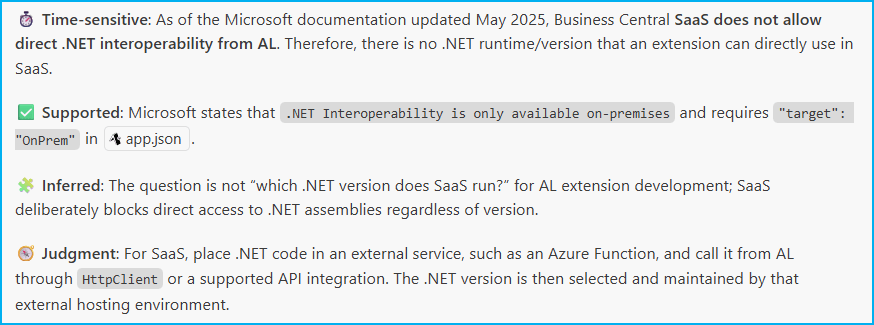
/ef Which version of .NET does Business Central SaaS currently use or allow the use of?
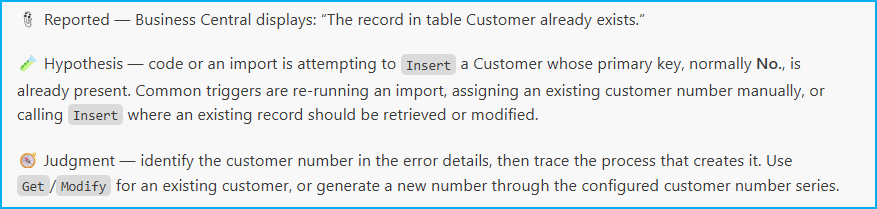
/ef An error message says: "The record in table Customer already exists." What is the cause?
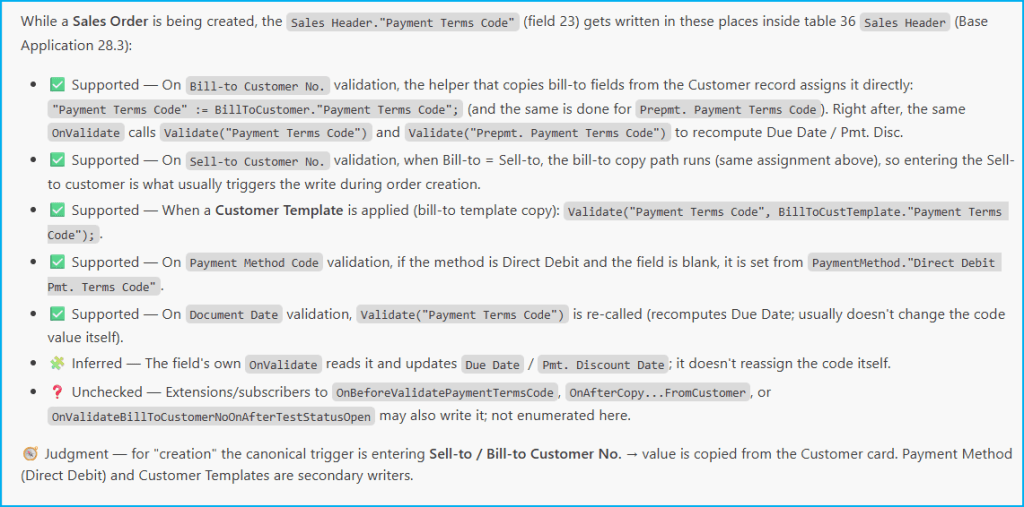
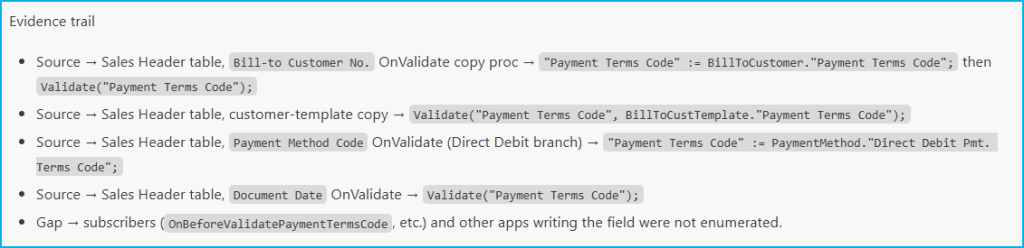
/ef check trail Where is the "Payment Terms Code" field changed while a sales order is being created?
What it does not do:
- It does not automatically verify that a claim is true.
- It does not assign a confidence score.
- ✅ Supported does not mean «absolute truth»: it means the claim is supported by evidence the model inspected during that conversation.
- It does not replace a technical review or validation in your environment.
- It is not enabled by default: for normal conversations, code, JSON, or creative content, Copilot responds as usual.
- The flags appear only when you enable them with /ef.
The skill is already published here: gdrgdev/evidence_flag, and I have tested it with regular cases and some traps: forced labels, sources attempting to give instructions, and responses without sufficient evidence. Now, before trusting a response, I can quickly distinguish what it has checked, what has been stated, and what it has inferred.
In the end, it is not about making AI seem more confident, but about knowing when it is worth trusting, checking, or asking more questions.
I hope this information helps you in your daily work with Business Central.
Más información / More information:



Deja un comentario